
The Sunday Post - Dec 28, 2025: 2025 Year in Review: Roads, Safety, Smart Growth, and Major Updates in 2026
- Michael-Paul Hart
- Dec 28, 2025
- 7 min read

A weekly report from Councilor Michael-Paul Hart — Building the Smartest City in America.
Volume 1, Issue 8

2025 in Review: What We Moved, What We Built, What Comes Next
As we close out 2025 and step into 2026, I want to share a straightforward recap of what we pushed forward this year, and where the focus goes next.
My approach is consistent: prioritize basics that affect daily life, especially roads and public safety, demand transparency in how dollars are spent, and pursue smart growth that strengthens neighborhoods over the long term.
Here are the highlights.

Roads and Infrastructure: Back to Basics
If you live in Indy, you do not need a speech about roads. You need progress.
That is why, during the Spring Fiscal process, my amendments were centered on directing more funding toward core infrastructure and roadway repair.
What I pushed for in Spring Fiscal
A clear “back to basics” message: prioritize potholes, resurfacing, and roadway
A DPW funding amendment that increased the capital allocation with explicit inclusion of street repair activities such as strip patching and related infrastructure commitments.
A “no blank checks” stance on certain public safety funding flows: if we are appropriating public dollars, we should receive a clear scope of work and reporting before additional funding is released.
Public Safety: Practical Proposals, Not Talking Points
Public safety remains a top concern across Indy, and it requires policy that is realistic, enforceable, and measurable.
In 2025, our caucus introduced a Public Safety Package built around three targeted proposals designed to address staffing shortages, juvenile issues tied to late-night incidents, and slow internal policy changes that impact policing effectiveness.
Public Safety Package: the three proposals
Remove non-state-mandated residency requirements for city employees to widen the talent pool and improve staffing and retention across city departments.
Enhance parental accountability for juvenile curfew violations, with escalating consequences: written notice, then a $500 fine, then $1,500 for repeat violations.
Reform the General Orders Advisory Board by restoring the Chief’s ability to issue and amend general orders effectively, while retaining public transparency and oversight through an advisory model.
2026 focus on public safety
General Orders reform through the Statehouse: I am actively engaging with state lawmakers on legislation that puts the General Orders Board in an advisory role and restores the Chief of Police’s ability to develop and update General Orders efficiently.
Staffing and operational speed: Keep pressing for practical reforms that widen the talent pool, improve retention, and remove administrative friction that slows down day-to-day policing.
Technology that improves outcomes, with transparency built in: Spend more time evaluating proven tools that help officers respond faster, deploy resources smarter, and document incidents more effectively, while being transparent about how these tools work and how they are governed.
Privacy protections for residents who are not causing problems: Ensure any new technology includes clear guardrails, auditing, and limits on unnecessary data collection so public safety improvements do not come at the expense of civil liberties.
The Google Data Center Debate

This year, the proposed Google data center became one of the most important “smart growth” tests Indianapolis has faced in a long time. It was not just a zoning case. It was a referendum on whether mega-projects get approved based on headlines and private deals, or whether they pass a clear, resident-first standard.
What was proposed
A hyperscale data center campus on hundreds of acres in Franklin Township, advanced by the Metropolitan Development Commission even after significant resident turnout and testimony.
Why I opposed it

Google and the city’s economic development team presented renderings and highlighted temporary construction jobs, but repeatedly avoided the questions that matter most to taxpayers and neighborhoods: long-term economic impact, the real tax base after abatements, utility strain, and quality-of-life impacts for nearby families.
Two issues, in particular, pushed this from “local zoning fight” to “citywide policy problem”:
Grid and reliability risk: I elevated what MISO has publicly warned about. One large data center can be like “adding a major metropolitan city” to the electric grid in terms of demand. That matters for reliability and ratepayer pressure if we approve projects before infrastructure planning is settled.
Process and transparency: In the final stretch, there were private promises aimed at building support, including a conversation where the Franklin Township Schools superintendent acknowledged being asked what it would take for him to support the project. That is not how major land-use decisions should be handled.

What we did: After MDC advanced the rezoning, I committed to calling it down so the full Council could hold a public hearing, ask hard questions, and give residents another real chance to be heard. We then set a clear timeline for the mediation and Council vote.
The outcome: On September 22, 2025, Google withdrew its petition rather than proceed to a final City-County Council vote. A withdrawal also means they can potentially re-file sooner than if they had lost a final vote.
What we learned: If Indiana wants data centers, the state must take a serious look at incentives and abatements that can strip local tax base while leaving communities to absorb infrastructure burden. Indiana already offers significant tax incentives for data centers, so local residents deserve open math and enforceable community benefits before projects move forward.
Washington Square Mall: Accountability and a Path Forward
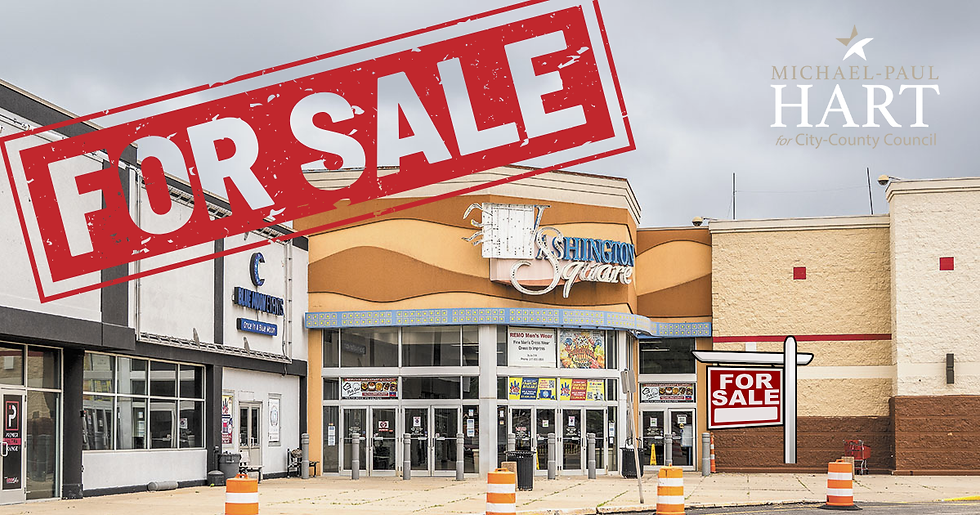
Washington Square remains the defining redevelopment challenge on the east side, and it is a perfect example of why “hope” cannot substitute for responsible site control, enforcement, and credible financing.
In 2025, we made real progress in a place where “progress” has been promised for years. That started with pressure and documentation, not press releases. We tracked ongoing enforcement actions and violations, including repair cases, trash orders, and escalating consequences tied to noncompliance.
At the same time, we kept pushing toward what actually moves a stalled property: aligning
stakeholders around a feasible end-state. Independent reporting captured what many residents already know from lived experience: the mall’s decline has been severe, vacancy is high, and the economics on-site look nothing like a healthy retail center. The same reporting also reflects the core reality we have been driving toward: without serious coordination between ownership, the City, and credible redevelopment partners, nothing changes.
This is why Washington Square is my top district priority going into 2026. We moved the needle in 2025, and we will kick off 2026 with important news. Stay tuned.
2026 focus
Keep pressure on enforcement and follow-through until the property meets basic standards
Align redevelopment conversations with reality: financing, ownership intent, and responsible site control
Pursue solutions that improve safety and convert the site into a productive community asset, not another decade of decline
Housing, Homelessness, and Quality of Life: Practical Action and a Local Policy Plan
Housing and homelessness require more than compassion. They require a serious plan, operational partners, and clear targets so we can measure what is working and scale it.
In 2025, we made progress in three ways that matter.
1) Real, visible improvement on the ground One of the clearest examples was the site behind

Walmart on Washington Street. We helped drive the coordination needed to get people connected to housing resources and services, and to get the area cleaned up and stabilized. This is not the kind of work that always shows up in headlines, but it is the kind of work residents notice because it changes daily life and restores basic order and safety.

2) Leading the community conversation through SmartIndy We hosted a public discussion and panel through SmartIndy to elevate the issue in a constructive way. The goal was not to score points, but to put facts and real solutions on the table, bring together people who work on the problem every day, and create a forum where residents could engage without the conversation turning into blame or politics.
3) Building a policy pipeline that local government can actually act on We also kicked off SmartIndy’s Housing and Homelessness Committee to move from “talking about the problem” to identifying the local levers we can pull.
That includes:
Zoning and land-use reforms
Permitting process improvements
Upstream solutions that reduce inflow into homelessness
The point of the committee is straightforward: define what we can change locally, build a practical agenda, and advocate for actions that produce measurable outcomes.
Quality of life is part of the same equation We also continued advancing the idea that neighborhood stability and environmental quality matter, including urban forest preservation. Safer streets, cleaner public spaces, and stronger neighborhood conditions are not separate from housing outcomes. They are connected.
2026 focus
Build a clear set of local policy priorities on zoning, permitting, and prevention
Expand partnerships that move people from unsheltered situations into housing pathways
Track outcomes publicly so residents can see what is changing and what is not
SmartIndy: Building a Civic Network That Produces Action

SmartIndy continued growing in 2025 because it is focused on practical outcomes, not noise. The goal is simple: create a civic network that elevates real problems, brings the right people together, and produces measurable progress at the neighborhood level.
What we accomplished in 2025
Public Safety Roundtable: convened public safety stakeholders around realistic solutions, not talking points.
Housing and Homelessness Panel: led a constructive public conversation and elevated the need for measurable outcomes and operational partners.
Tenants Rights Pop-Up Event: hosted a pop up event in Knoll Ridge Apartments to educate renters on how to use Code enforcement, Health Department, and local legal aid tools.
Housing and Homelessness Committee: launched a working group focused on identifying local levers we can pull, including zoning, permitting, and upstream prevention strategies.
Just as important, we built a strong internal team. SmartIndy is not a one-person brand. It is becoming a disciplined network with people who are willing to do the work.
2026 focus
Community Engagement Meetings to expand participation, recruit additional leaders, and connect SmartIndy work directly to neighborhood priorities.
Education discussions to bring the same practical, solutions-first approach to how we strengthen schools, workforce pathways, and student outcomes.
Grow the team and the network: continue recruiting operators, subject-matter leaders, and neighborhood voices across Marion County.
Publish clearer scorecards: define what success looks like for each issue area and report progress in a way residents can track.
Keep executing on the theme: building the Smartest City in America through measurable, neighborhood-level results.

✅ Follow Council updates and share your feedback
✅ Send me topics you’d like to see featured in The Sunday Post
✅ Invite a friend to subscribe at michaelpaulhart.com/blog

Thank you for reading Indianapolis City Council Updates and for supporting common‑sense leadership. Together, and with the community driving accountability, we are turning bold ideas into real‑world results.
Accountability, Transparency and Local Leadership
See you next week with more updates from the Neighborhood.


Comments