
The Sunday Post - July 19, 2026: The DC BLOX Decision, What It Brings, and a Wheel Tax Veto
- Michael-Paul Hart
- 2 days ago
- 6 min read
A weekly report from Councilor Michael-Paul Hart — Building the Smartest City in America.
Volume 2, Issue 29

The DC BLOX Decision

I didnt have a vote but I verbally I supported it, and I want to explain that decision plainly.
The Commission's approval followed a thorough review through the use variance process to determine whether this development was appropriate for its location. After reviewing the facts, I concluded that the project is compatible with the existing I-3 industrial corridor and provides a level of investment in the East Side that is difficult to match.
Residents raised legitimate questions throughout this process about environmental impacts, noise, traffic, and the project's proximity to homes and a school.
Those concerns deserved to be heard and carefully evaluated. Throughout the review, the project was subject to environmental regulations, technical studies, and written commitments.
On balance, I believe the benefits outweigh the impacts and I intend to hold the developer accountable to every commitment made during the approval process.
What This Project Actually Brings

Much of the public conversation has focused on what a data center is. Very little of it has focused on what this agreement delivers to the neighborhoods around it.
One thing worth noting first: over the course of this review, the project was reduced in physical size in response to community input. The estimated tax base and the community benefits did not shrink with it. Residents got a smaller building footprint without giving up the investment.
Here is the community package. These are estimates, and I will report changes as they are finalized:
$10 million to MSD Warren Township schools over the next ten years
$11 million to the Irvington TIF — dollars that stay in Irvington
$5 million toward the Washington Square Mall infrastructure project
$2.5 million toward a community project, with the goal of repurposing the Ransburg facility
That is roughly $28.5 million in estimated community benefit.
The Irvington piece matters to me personally. I created that TIF district in 2022 so that growth in property tax dollars generated on the east side would stay on the east side and fund things like Irvington Plaza, Ellenberger Park, Irving Circle Park, and Christian Park. This is exactly what that tool was built to do.
Beyond the community package, the project is projected to represent roughly $2 billion in private investment. It is expected to support about 21 permanent positions at an average wage of $55 an hour, plus an estimated 60 to 70 indirect jobs, and to peak at around 600 workers on site during construction, built with local union labor.
For context: that property generates about $27,000 a year in taxes today.
What Could Have Been Built There Instead

This is the part of the conversation I wish had gotten more attention.
The site is the former Ford steering gear factory at Thunderbird Commerce Center. It is a brownfield. It is already zoned I-3, Medium Industrial.
Under that zoning, a long list of uses is permitted by right, meaning no variance, no community meeting, no negotiated commitments, and no vote. That list includes:
Scrap metal, industrial, and e-waste recycling
Junk yards and tow lots
Truck and trailer repair, and heavy vehicle washing
Fleet terminals and heavy outdoor storage
Warehousing, distribution, and light to medium manufacturing
Several of those uses already operate on the adjacent parcels.
Any of them could have gone in without a single public commitment attached. That is the honest alternative that was on the table.
The Safeguards on the Record

These are some of major commitments I will be holding the company to:
Noise limited to under 65 decibels at the property line — comparable to a washing machine
No evaporative cooling, with total water use a small fraction of what residents expected
Diesel particulate filters on every generator, with testing limited to 30 minutes monthly and four hours annually, weekdays only, between 7:00 a.m. and 5:00 p.m.
A significant projected reduction in annual emissions compared to by-right heavy vehicle use at the site
DC BLOX pays all associated costs for utility upgrades to distribution, transmission, and generation
Enrollment in a renewable Green Power Flex program for energy used
Substantially reduced parking, meaning less asphalt and less runoff
Pennsy Trail restoration — invasive species control, native seeding, and three years of maintenance, plus mounding between the trail and the buildings
That fifth point deserves emphasis. The company pays for its own power infrastructure. That is the standard I have argued for from the beginning: large users cover their own energy and water demand so those costs do not land on residential utility bills.
Zoning Rules, or a Moratorium?
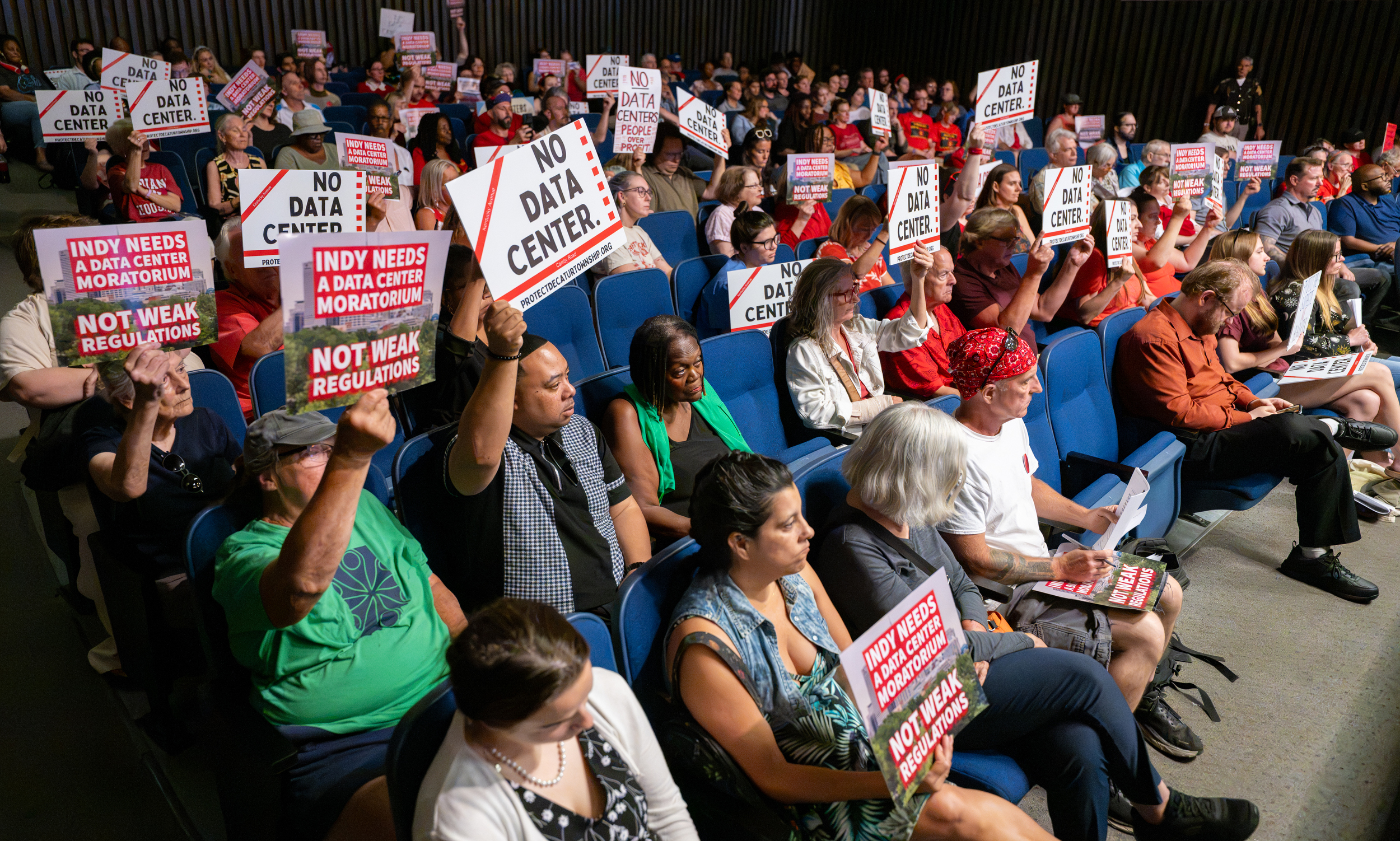
Two separate proposals are moving at the same time, and they are easy to confuse.
The first would create a new zoning classification for data centers, SU-47. Indianapolis currently has no zoning category written specifically for this use.
I support it.
The rezoning and call-down process is critical for community members to make their voices heard. Recent proposals demonstrated the weakness of allowing data centers to proceed through use variances. The proposed zoning ordinance applies those lessons by creating a definition, development standards, reporting requirements, and a direct path to public and Council review.
That is a better system than the one we have now — for residents and for developers.
The second proposal is a moratorium, a temporary pause on approving any new data centers. A Council committee voted to recommend it on July 13.
I do not support a blanket pause.
Write the rules. Set the standards. Require large users to cover their own energy and water demand. Put every agreement in public view.
A pause delays the decision. Standards decide it.
The Wheel Tax Was Vetoed

Last week I wrote that the wheel tax increase had passed the Council with 14 votes but was not final.
On Friday, the mayor vetoed the proposal.
It now returns to the City-County Council in August.
Overriding a mayoral veto requires 17 votes. Supporters were three short at passage. One councilor was absent and is expected to support it, which still leaves a gap of two.
I have also been working on an alternative. Following the state's recent guidance on local income tax changes, I put together a plan for meeting the escalating Community Crossings road match without a new tax on drivers.
Roads have to be funded. The question is whether we fund them by raising costs on residents or by prioritizing the dollars we already collect.
That debate happens in August.
A New Home on Fenton Avenue

On Friday afternoon I had the honor of speaking at a home dedication on South Fenton Avenue, where the Riley family cut the ribbon on a new Habitat for Humanity home.
I spent eight years working in the trades before I ever held office, so I have a particular appreciation for what goes into a house, and for the volunteers who framed, wired, and finished this one.
Homeownership is how families build stability, and it is how neighborhoods hold together.
This is what housing policy looks like when it stops being a spreadsheet and becomes a front door with a key in it.
Congratulations to the Riley family. Welcome home.

Housing and Homelessness Work Continues

Two other conversations this week connected to the same issue.
On Thursday, the SmartIndy Housing and Homelessness Committee met at the Southeast Community Center on Shelby Street.
On Friday, I joined a Streets to Home Indy discussion with CHIP Indy and partners working toward permanent housing solutions.
These are not quick problems, and I will not pretend otherwise. But the work is moving, and it is being done by people who show up month after month.
Around the District and the City
130 S. Mitthoeffer Road. Several residents contacted me about grading and asphalt work at this site and about runoff toward Morris Ditch. I became aware of the activity this week and am working to learn more about the project and the permits behind it. I will report back.
Opportunity Zone 2.0. I approved moving forward with a District 20 submission covering the census tract that includes Washington Square Mall. If selected, it becomes another tool for east side redevelopment.
Regional work. I attended the CIRDA board meeting at IU Indianapolis. Much of what shapes Indianapolis — roads, housing, workforce — is decided regionally, and it deserves more attention than it gets.
Veterans and small business. I stopped by the VentureVets "Between Two Corns" event downtown, which supports veterans building businesses in Indiana.
✅ Follow council updates and share your feedback
✅ Send me topics you would like to see featured in The Sunday Post
✅ Invite a friend to subscribe at michaelpaulhart.com/blog
Thank you for reading Indianapolis City Council Updates and for supporting common-sense leadership. Together, and with the community driving accountability, we are turning bold ideas into real-world results.
Accountability, Transparency and Local Leadership
See you next week with more updates from the Neighborhood.